The UK Tax Year Ends Soon: 7 Smart Moves to Maximise Your Benefits Before 5 April
The UK tax year ends 5 April — and if you haven't used your allowances, you lose them for good. But end-of-year planning isn't just about saving tax. It's about making the most of the structural advantages built into the UK system to protect your wealth, grow it faster, and keep more of what you earn.


The UK tax year runs from 6 April to 5 April. Once it ends, many allowances reset — and if you haven’t used them, you lose them.
Here’s a practical checklist to make sure you’re not leaving money on the table:
1. Max Out Your ISA Allowance (£20,000)
Under the rules set by HM Revenue & Customs, you can invest up to £20,000 per tax year across ISAs:
- Cash ISA
- Stocks & Shares ISA
- Lifetime ISA
- Innovative Finance ISA
Why it matters:
- All growth is tax-free
- No capital gains tax
- No dividend tax
- No income tax on interest
If you invest £20,000 today and it compounds at 7% annually for 20 years, that’s over £77,000 completely tax free.
If you don’t use this year’s allowance by 5 April, it’s gone forever.
2. Increase Pension Contributions (Especially via Salary Sacrifice)
Pension contributions are one of the most powerful tax tools in the UK.
You can usually contribute up to:
- £60,000 per year
- Or 100% of your annual earnings (whichever is lower)
Through Salary Sacrifice:
- You reduce taxable income
- You save income tax
- You save National Insurance
- Your employer may match contributions
For higher-rate taxpayers (40%+), the effective return on pension contributions can be enormous due to tax relief.
Self-employed? A Self-Invested Personal Pension (SIPP) gives you similar tax benefits.
3. Use Your Lifetime ISA (If You’re Eligible)
If you’re under 40, a Lifetime ISA lets you contribute up to £4,000 per year, and the government adds a 25% bonus.
That’s up to £1,000 per year.
You can use it for:
- First home purchase
- Retirement (after age 60)
Miss the 5 April deadline, and you miss the bonus for this year.
4. Consider EIS or SEIS Investments
If you’re a higher-income individual or angel investor, the Enterprise Investment Scheme (EIS) and Seed Enterprise Investment Scheme (SEIS) are powerful.
SEIS:
- 50% income tax relief
- Capital gains exemptions (if held 3 years)
EIS:
- 30% income tax relief
- Capital gains deferral
- Loss relief if the investment fails
These are high-risk investments in early-stage companies — but tax relief significantly reduces downside risk.
Tax-year timing matters here.
5. Use Your Capital Gains Allowance
The annual CGT allowance has been reduced significantly in recent years.
Before 5 April, consider:
- Realising gains up to your allowance
- Bed-and-ISA strategies
- Rebalancing portfolios
Unused CGT allowance does not carry forward.
6. Check Your Dividend Allowance
The dividend allowance is now only £500.
If you:
- Own shares outside ISAs
- Have a limited company
- Take dividends as income
Make sure you’ve optimised dividend timing before the tax year resets.
7. Review Salary, Bonuses & Tax Bands
If you're near:
- The £50,270 higher-rate threshold
- The £100,000 personal allowance taper
- The £125,140 additional rate threshold
Strategic pension contributions before 5 April can:
- Restore lost personal allowance
- Avoid 60% effective tax traps
- Reduce marginal tax exposure
The Big Picture
End-of-tax-year planning isn’t just about “saving tax.”
It’s about:
- Improving net wealth trajectory
- Increasing compounding
- Using structural advantages built into the UK system
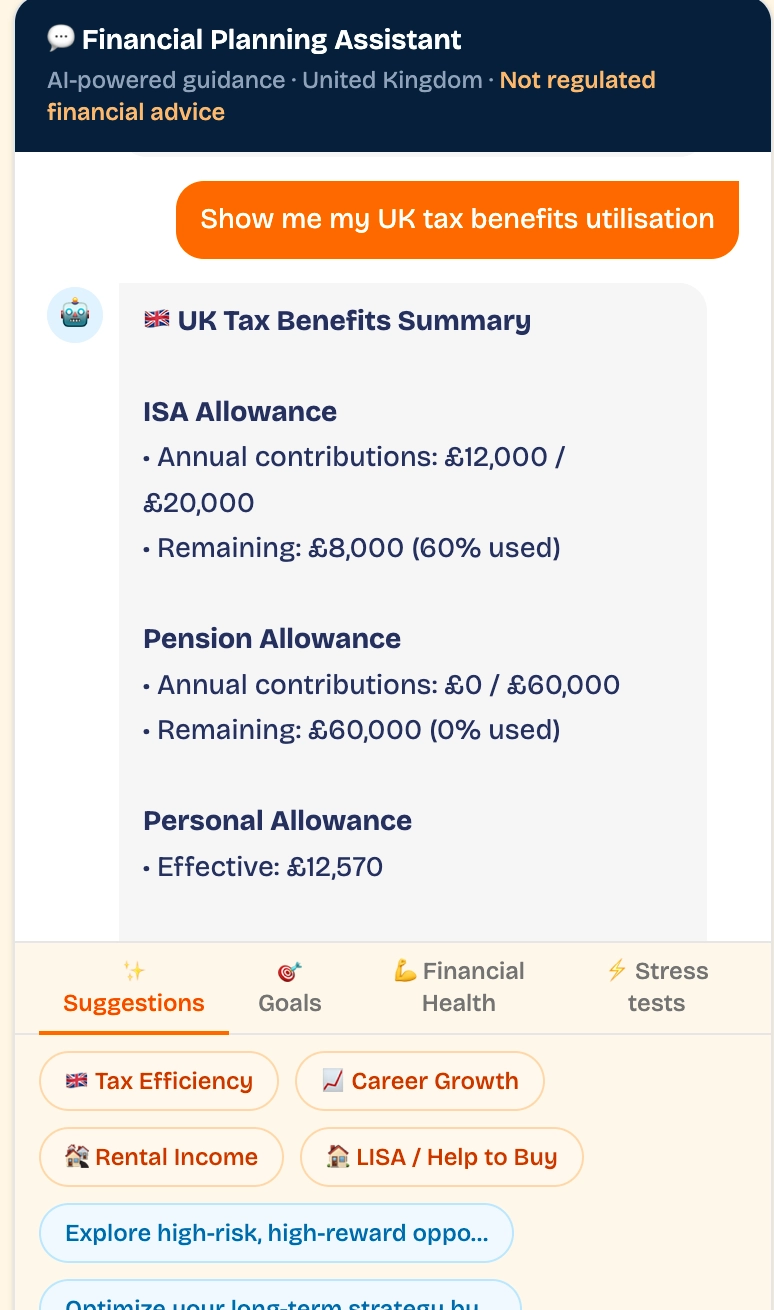
At Moola, you can use the Tax Efficiency feature in the Financial Planning Assistant to see how much of your UK tax benefits you’re using, and how much more you can utilise. Click on “Suggestions” and “Tax Efficiency” to get the most out of your money.